Year
2025
Client
Johnny Harris / New Press
Category
Broadcast Graphics
Product Duration
2 Months
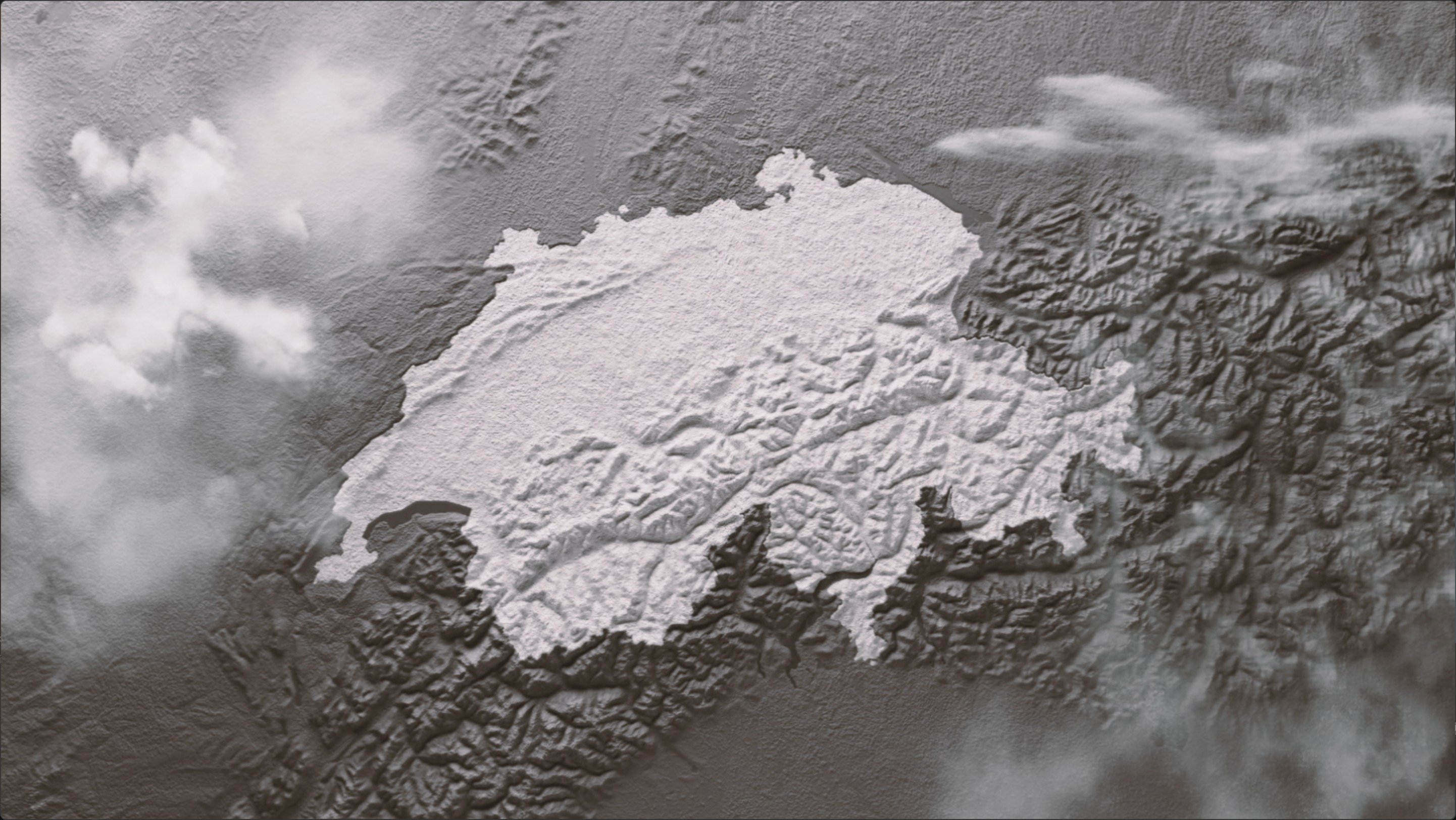
The documentary covered Switzerland's legendary mountain rail system: the Simplon Tunnel, the Lötschberg, the Jungfrau routes. For audiences to understand why these trains are remarkable, they first needed to understand the terrain they're punching through. That's what the maps had to do.
Eight shots total: wide establishing views of the alpine routes, tunnel entrance zooms, cutaways showing the train paths running deep inside the rock, and a country-level zoom to Locarno. Each one had to be accurate enough to trust and cinematic enough to hold a viewer's attention.
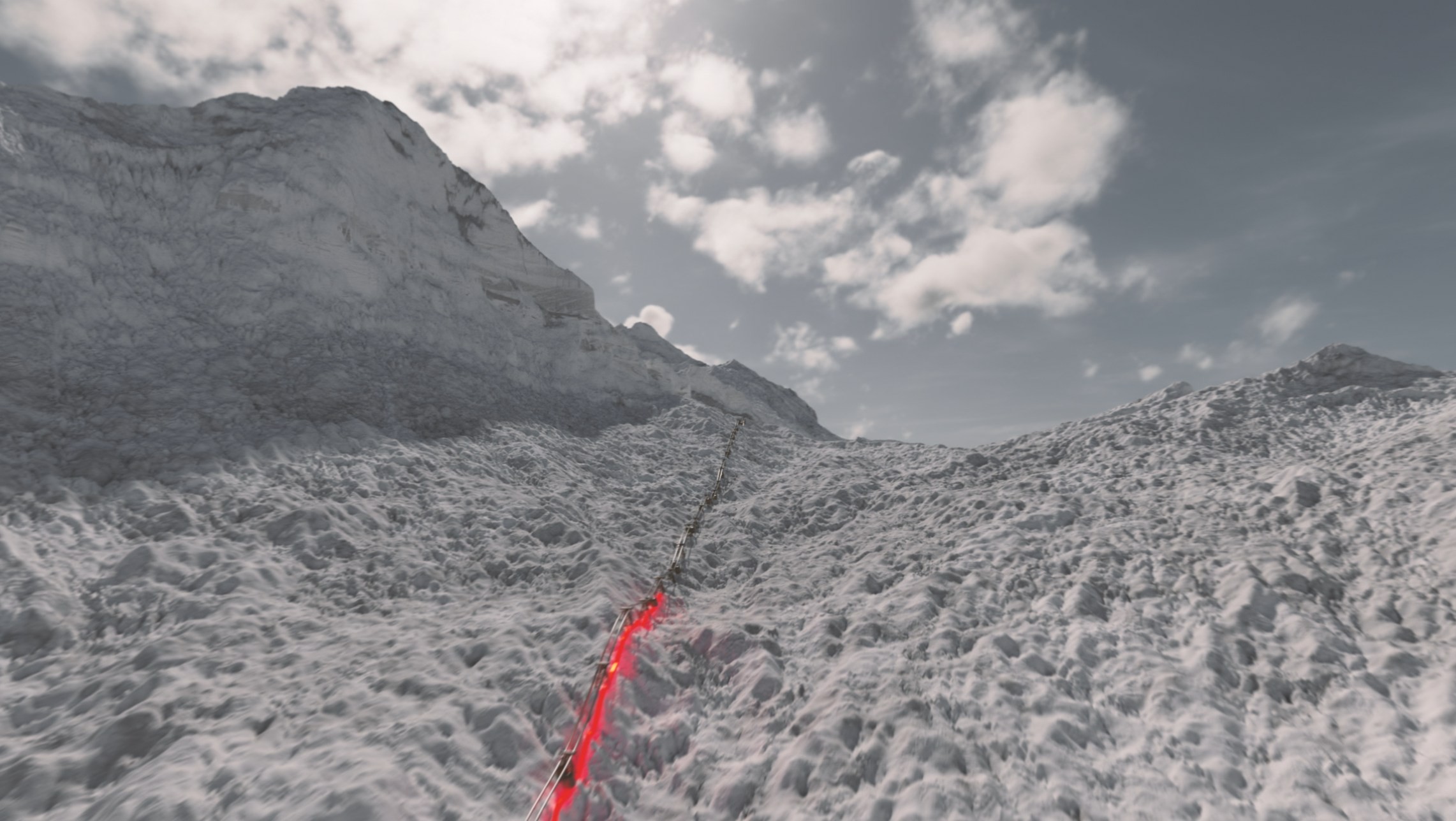
The visual language was settled early: light-colored stylized terrain with exaggerated relief, glowing red route lines tracing the train paths, camera pace slow enough to feel like you're actually moving through the Alps.
The tunnel shots were the real design problem. Showing a route disappear into a mountain and making clear what's happening inside meant the maps had to reveal something terrain maps don't usually show. We explored a clean geometric cutaway that sliced the mountain open, and a semi-transparent fade where the rock dissolved just enough to show the glowing path running through it. Both approaches had to communicate the same thing: these tunnels are cutting through enormous mountains, and the tunnel itself is tiny by comparison.
Johnny was precise through revisions. He wanted the route line flush on the surface not hovering, with a thin black railroad line beneath it, hatched old-cartographic style. He wanted the tunnel entrance approach to feel like a convergence: camera gliding toward the mountain wall at the same pace the route line was moving, both arriving at the entrance at the same moment.
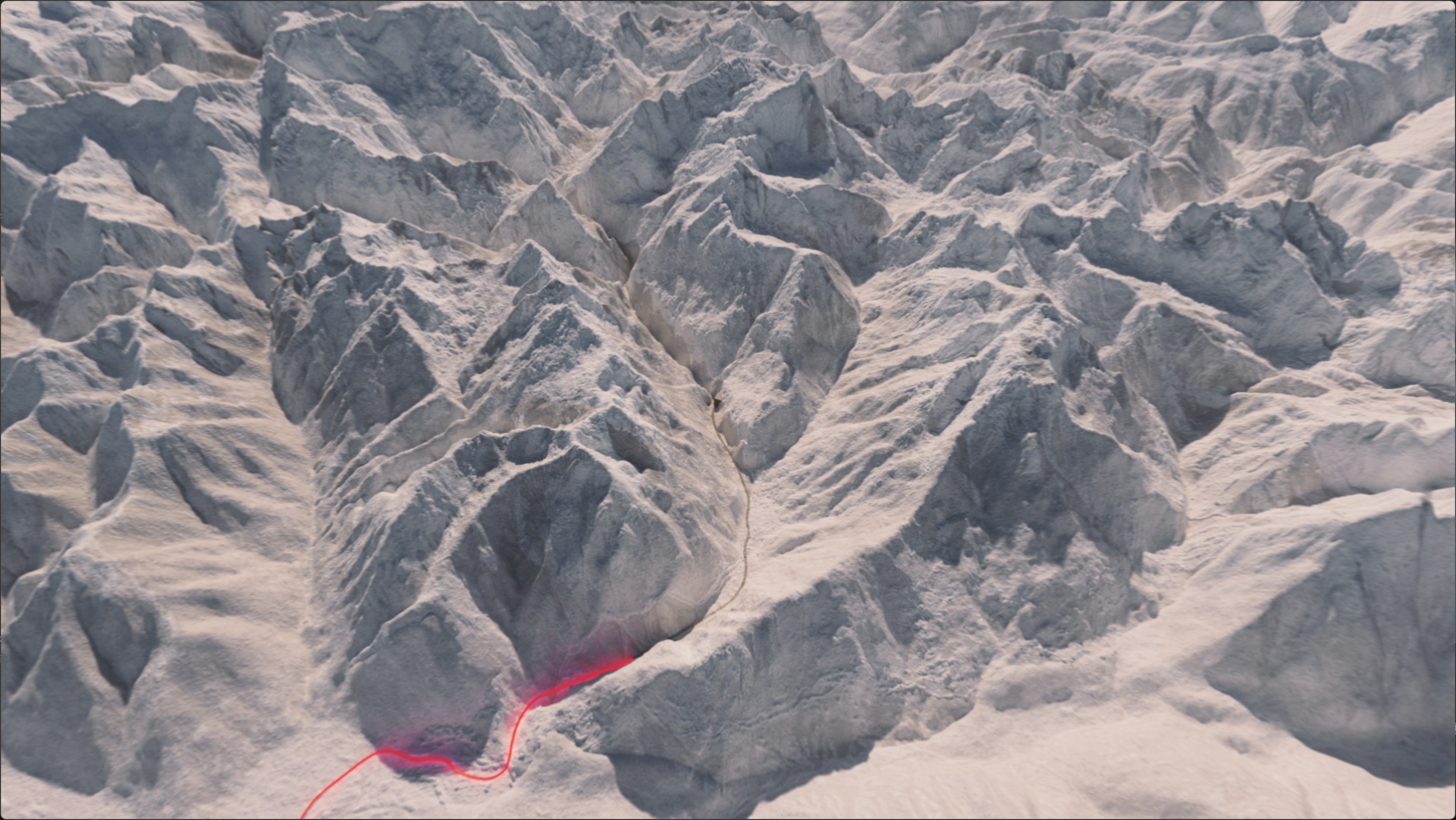
Terrain was built from GIS and DEM elevation data, then stylized. Exaggerated vertical relief, simplified rock shading, depth-of-field treatment that made foreground mountains feel present and pushed the background ranges into the atmosphere.
The cutaway shots were the most involved. Getting the mountain interior to read as a mountain not an abstract void required layering in geological shading, fog for depth, and compositional control that kept the mountain mass dominating the frame. The tunnel line had to be thin. Scaled to what a real train tunnel looks like relative to an alpine peak, it nearly disappears from a wide shot. That's the point.
Tools: Houdini, Redshift.
The maps ran throughout the documentary. They're the kind of visuals that work when viewers don't consciously register them as graphics, when the geography just feels understood.
Johnny's take mid-production: "This look is sick. The white, the shadows, the depth of field, the texture, it's all looking really, really nice."
That reaction early in the process told us the foundation was right. Everything after that was refinement. Which, on a project like this, is most of the work.